New technologies promise to support collaborative research and other interpretive activities, and so it's really good when you see a well-structured example appear on the internet.
In an 'experiment in close-reading', seven critics, scholars and creative writers were invited to participate in an online discussion of Doris Lessing's novel The Golden Notebook. With the approval of the author and publisher Harper Collins, the full-text of the novel is provided so that those outside of the chosen group can consider the 'readings' provided by each contributor with easy reference to the page or pages under discussion. The concentration of discussion on particular pages can also be examined in a section that arranges comments per page in descending order.
The 'reading' of the novel began on 8 November 2008 and continued for approximately six weeks. Observers have been invited to comment in a Forum and the chosen readers reflected on their experience in a blog. This is all arranged in a very simple interface that enables visitors to concentrate on the text of the novel and the attached comments.
Comments in the Forum show a mixed reaction to the experiment, some questioning the veracity of the 'reading' being done online and others suggesting the need for readers outside of the English-speaking world. But, despite this criticism, most people who have added their voice to the discussion have been positive. For an online experiment, the small numbers who have posted comments might be disappointing to the organisers, but one might wonder how this could develop as more people become aware of the site's existence.
This experiment in close reading provides a very good model for similar initiatives using full-text through the AustLit portal. Agreements with authors and publishers will have to be made for contemporary works, but those works out of copyright provide the possibility for trial and experimentation.
The Aus-e-Lit Project will develop new annotation tools to support experiments like The Golden Notebook and will soon invite contributors to participate in an annotation event that centres on The Bulletin Story Book which contains a number of well-known Australian short stories, including Henry Lawson's 'The Drover's Wife', Barbara Baynton's 'The Tramp' (a version of 'The Chosen Vessel') and Arthur Hoey Davis' 'On Our Selection' among many other well-known and long-forgotten stories.
This event will inform the development of collaborative annotation tools by inviting wide participation and feedback on the technical and conceptual delivery of such a service to researchers in the field of Australian literature. The release of this development model will be announced here and through other AustLit networks in the near future. The prototype will be discussed in a special session at ASAL 2009.
Tuesday, June 16, 2009
Wednesday, June 3, 2009
Aus-e-Lit Project Update
Over the last six months Aus-e-Lit team members have been busy with technical and conceptual development and have appeared at a number of events to spread the news about the tools that will soon enable greater engagement with AustLit data.
Papers have been presented at eResearch Australasia 2008, International Digital Curation Conference 2008, International Conference on Asia-Pacific Digital Libraries 2008, International Conference on Open Repositories 2009 and Digital Humanities 2009. Copies of these papers have been posted on the Project site - here.
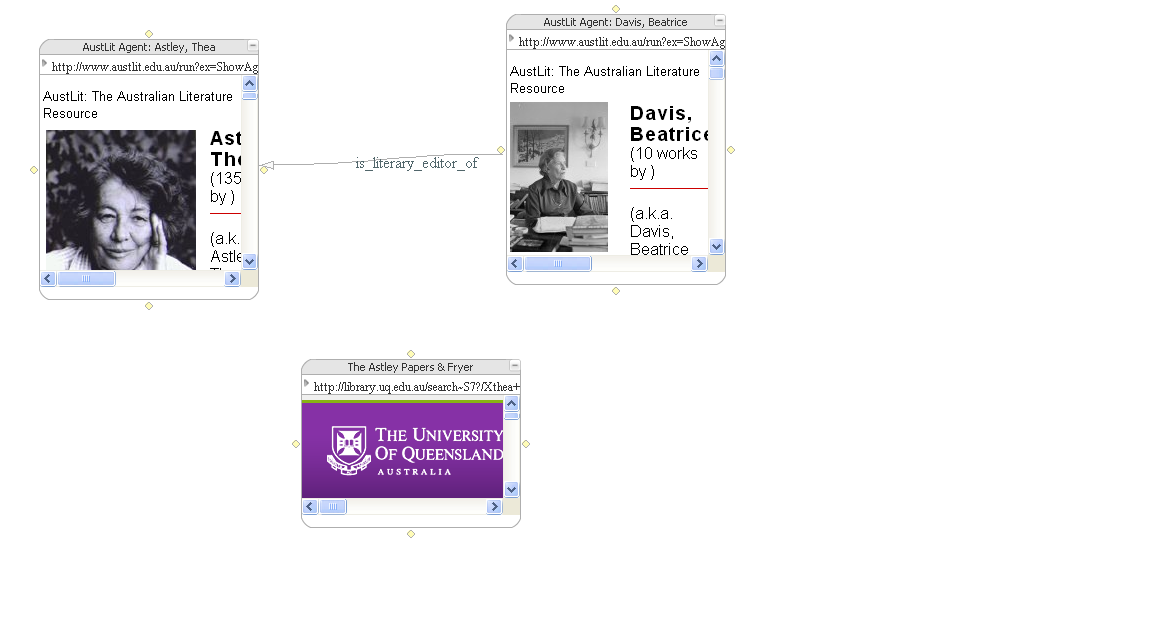
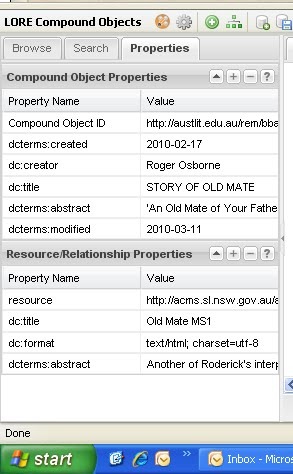
The Project's goal is to help AustLit users to discover, organise, describe, analyse, collaborate and communicate in a networked environment. This will be achieved by providing a federated search of selected databases, an annotation service and a new tool, LORE, that will enable users to create and publish compound digital objects in a variety of presentation forms. You can view a video of these tools in use that was prepared by Anna Gerber for Open Repositories 2009.
In addition to conference presentations, these new tools have been demonstrated to members of the Austlit user community based at the University of Queensland. AustLit personnel and staff members from the School of English, Media Studies and Art History have been asked to comment on prototypes of the Aus-e-Lit tools. Feedback on the prototypes has been positive and comments have informed the preparation of a demonstration and workshop at the annual conference of the Association for the Study of Australian Literature.
In consultation with members of research communities active in the field of Australian literary studies, the project team is preparing several examples that will be used for demonstration at ASAL and beyond.
The project has attracted the interest of Professor Paul Eggert who has a considerable international reputation in the field of scholarly editing. Professor Eggert is currently working on a major scholarly edition of the works of the colonial Australian poet, Charles Harpur. Harpur's poetry exists in manuscript, periodical and book versions that reveal significant variation due to the poet's constant revision towards a collected edition that failed to appear during his lifetime. An edition of Harpur's poetry was prepared after his death, but severe editorial intervention created texts that depart significantly from the last known manuscript versions. The Aus-e-Lit project is using the case of 'The Creek of the Four Graves' to develop tools to assist collaborative scholarly editing. You can see a video of the basic structure of the prototype here.
Discussion with teachers of Australian literature in EMSAH has isolated a few texts that can be used to develop tools that assist collaborative analysis of literary works. Henry Lawson's well-known short story 'The Drover's Wife' will be used as a test-case to investigate the benefits of collaborative annotation. Published in The Bulletin Story Book in 1901, its appearance in this book enables discussion of other texts such as Barbara Baynton's 'The Tramp' and Arthur Hoey Davis' 'On Our Selection' and an exploration of the literary culture of the 1890s that centres on writers whose work appeared in the Bulletin during that decade.
The project team has also been investigating the benefits of online text analysis tools like those offered by Tapor or demonstrated at the Willa Cather Archive. Over time and in consultation with AustLit users we'll be testing these tools and will direct users to the best of them so that AustLit research communities can take full advantage of the increasing amount of full text freely available on the web. In the near future the project will also offer data visualisation tools to support 'distant reading' of Australian literary history by drawing on the rich data source collected by AustLit.
Such visualisation will potentially help projects such as Professor David Carter's 'America Publishes Australia: Australian Books and American Publishers, 1890-2005.' Evidence accumulated during this project could potentially enhance AustLit records by providing information not normally indexed by AustLit: literary agents; publisher's representatives; editors; print runs; dustcover images; comprehensive bibliographical descriptions etc. Examples from this project will be developed to demonstrate how the accumulation of such data might be analysed and re-used for other research questions.
The potential for the re-use of digital objects is being explored with the help of AustLit's Black Words Research Community. Black Words team members are drafting a variety of thematic trails that can be created by using LORE to collect, organise and present web-based digital objects. These trails will eventually be delivered through the Black Words page and will inform the development of style sheets for other types of presentations from slide shows to illustrated essays. Of course, our thinking is often influenced by the exhibits now accumulating at NINES.
Following the forthcoming demonstration and workshop at ASAL, we hope to enagage more users with the various prototypes in order to prepare for a full usability study in 2010. We welcome comment at any time via this blog or by email to the project manager, Roger Osborne: r.osborne@uq.edu.au.
Papers have been presented at eResearch Australasia 2008, International Digital Curation Conference 2008, International Conference on Asia-Pacific Digital Libraries 2008, International Conference on Open Repositories 2009 and Digital Humanities 2009. Copies of these papers have been posted on the Project site - here.
The Project's goal is to help AustLit users to discover, organise, describe, analyse, collaborate and communicate in a networked environment. This will be achieved by providing a federated search of selected databases, an annotation service and a new tool, LORE, that will enable users to create and publish compound digital objects in a variety of presentation forms. You can view a video of these tools in use that was prepared by Anna Gerber for Open Repositories 2009.
In addition to conference presentations, these new tools have been demonstrated to members of the Austlit user community based at the University of Queensland. AustLit personnel and staff members from the School of English, Media Studies and Art History have been asked to comment on prototypes of the Aus-e-Lit tools. Feedback on the prototypes has been positive and comments have informed the preparation of a demonstration and workshop at the annual conference of the Association for the Study of Australian Literature.
In consultation with members of research communities active in the field of Australian literary studies, the project team is preparing several examples that will be used for demonstration at ASAL and beyond.
The project has attracted the interest of Professor Paul Eggert who has a considerable international reputation in the field of scholarly editing. Professor Eggert is currently working on a major scholarly edition of the works of the colonial Australian poet, Charles Harpur. Harpur's poetry exists in manuscript, periodical and book versions that reveal significant variation due to the poet's constant revision towards a collected edition that failed to appear during his lifetime. An edition of Harpur's poetry was prepared after his death, but severe editorial intervention created texts that depart significantly from the last known manuscript versions. The Aus-e-Lit project is using the case of 'The Creek of the Four Graves' to develop tools to assist collaborative scholarly editing. You can see a video of the basic structure of the prototype here.
Discussion with teachers of Australian literature in EMSAH has isolated a few texts that can be used to develop tools that assist collaborative analysis of literary works. Henry Lawson's well-known short story 'The Drover's Wife' will be used as a test-case to investigate the benefits of collaborative annotation. Published in The Bulletin Story Book in 1901, its appearance in this book enables discussion of other texts such as Barbara Baynton's 'The Tramp' and Arthur Hoey Davis' 'On Our Selection' and an exploration of the literary culture of the 1890s that centres on writers whose work appeared in the Bulletin during that decade.
The project team has also been investigating the benefits of online text analysis tools like those offered by Tapor or demonstrated at the Willa Cather Archive. Over time and in consultation with AustLit users we'll be testing these tools and will direct users to the best of them so that AustLit research communities can take full advantage of the increasing amount of full text freely available on the web. In the near future the project will also offer data visualisation tools to support 'distant reading' of Australian literary history by drawing on the rich data source collected by AustLit.
Such visualisation will potentially help projects such as Professor David Carter's 'America Publishes Australia: Australian Books and American Publishers, 1890-2005.' Evidence accumulated during this project could potentially enhance AustLit records by providing information not normally indexed by AustLit: literary agents; publisher's representatives; editors; print runs; dustcover images; comprehensive bibliographical descriptions etc. Examples from this project will be developed to demonstrate how the accumulation of such data might be analysed and re-used for other research questions.
The potential for the re-use of digital objects is being explored with the help of AustLit's Black Words Research Community. Black Words team members are drafting a variety of thematic trails that can be created by using LORE to collect, organise and present web-based digital objects. These trails will eventually be delivered through the Black Words page and will inform the development of style sheets for other types of presentations from slide shows to illustrated essays. Of course, our thinking is often influenced by the exhibits now accumulating at NINES.
Following the forthcoming demonstration and workshop at ASAL, we hope to enagage more users with the various prototypes in order to prepare for a full usability study in 2010. We welcome comment at any time via this blog or by email to the project manager, Roger Osborne: r.osborne@uq.edu.au.
Friday, December 12, 2008
Resourceful Reading: The New Empiricism, eResearch and Australian Literary Culture
The Resourceful Reading Conference was held at the University of Sydney on 4-5 December.
The conference brought together researchers from fields such as literary studies and mathematics , librarians, database managers, programmers and publishers.
The keynote speakers, Professor Hugh Craig from the University of Newcastle's Centre for Literary and Linguistic Computing and David Carter, Professor of Australian Literature and Cultural Studies from the University of Queensland, set the tone for a highly productive meeting. Professor Craig's discussion of high-level data analysis supported by computational stylistics was complemented by Professor Carter's reflection on the emergence of 'new empiricism' from the institutional dominance of 'theory' in recent decades.
Under the banner of 'new empiricism', the conference provided a forum for archive-based approaches to the study of literary history and the 'distant reading' enabled by computer analysis of large amounts of data. At one extreme Kathie Barnes (paper delivered in her absence by Paul Eggert) and Roger Osborne discussed their explorations in the papers of David Malouf and Kylie Tennant. At the other, the collaboration between Julieanne Lamond and Mark Reid showed the possibilities of data visualisation based on library borrowing records from Tim Dolin's Australian Common Reader. Between these two extremes within 'new empiricism', a number of research projects were discussed at the conference, demonstrating the variety of new empirical approaches currently operating within the field of Australian literary studies.
These included demonstrations of developments within databases such as AustLit, AusStage, APRIL , Ken Gelder's Colonial Popular Fiction Digital Archive and Pat Buckridge's plans for an Australian version of the British Reading Experience Database.
The conference brought together researchers from fields such as literary studies and mathematics , librarians, database managers, programmers and publishers.
The keynote speakers, Professor Hugh Craig from the University of Newcastle's Centre for Literary and Linguistic Computing and David Carter, Professor of Australian Literature and Cultural Studies from the University of Queensland, set the tone for a highly productive meeting. Professor Craig's discussion of high-level data analysis supported by computational stylistics was complemented by Professor Carter's reflection on the emergence of 'new empiricism' from the institutional dominance of 'theory' in recent decades.
Under the banner of 'new empiricism', the conference provided a forum for archive-based approaches to the study of literary history and the 'distant reading' enabled by computer analysis of large amounts of data. At one extreme Kathie Barnes (paper delivered in her absence by Paul Eggert) and Roger Osborne discussed their explorations in the papers of David Malouf and Kylie Tennant. At the other, the collaboration between Julieanne Lamond and Mark Reid showed the possibilities of data visualisation based on library borrowing records from Tim Dolin's Australian Common Reader. Between these two extremes within 'new empiricism', a number of research projects were discussed at the conference, demonstrating the variety of new empirical approaches currently operating within the field of Australian literary studies.
These included demonstrations of developments within databases such as AustLit, AusStage, APRIL , Ken Gelder's Colonial Popular Fiction Digital Archive and Pat Buckridge's plans for an Australian version of the British Reading Experience Database.
Monday, November 3, 2008
NINES
NINES is the acronym for Networked Infrastructure for Nineteenth-century Electronic Scholarship, a ground-breaking digital project hosted by the University of Virginia. NINES aggregates a large collection of digital projects devoted to the 'long nineteenth century' by indexing their content and providing a comprehensive searching and authoring facility through the NINES interface. From the beginning of 2009, NINES will also support an 'exhibit builder', enabling users to arrange and publish the items they discover in annotated bibliographies, course syllabi and illustrated essays.
The NINES Collex Interface offers an excellent model for the development of Aus-e-Lit. The initial federation of selected databases in the Aus-e-Lit Project could be presented to users in a way similar to that employed by NINES, but the FRBR bibliographic model employed by AustLit will remain the foundation for the records of individual works. So, too, the new interface will be built on AustLit foundations. For example, to see how AustLit currently represents Patrick White's Voss click here. AustLit users can get to such records through Quick, Guided and Advanced Searches, producing a result that will look something like this. Aus-e-Lit programmers are currently working with the current AustLit interface and the selected databases to provide the best interface for the display of federated data. The first versions will be tested in December and trialled throughout 2009.
The Aus-e-Lit team is looking forward to the appearance of the new version of Collex which will include an 'exhibit builder'. Example exhibits have been mounted on the NINES web-site, providing a preview of what the exhibit builder can do, but it will be informative to see how the collection of exhibits grows after the tool is released. The collaboration or interaction of the NINES community is essential for the growth and enrichment of metadata that links and describes digital items from the many contributing projects. The collection and organisation of digital objects combined with the enrichment of keywords and annotations will build an increasingly rich infrastructure of data for present and future researchers of nineteenth century literature and culture. With its origins in the 'long nineteenth century', Australian literature has a lot to contribute to knowledge of the period. The current stage of development will make it difficult to offer the stability required by NINES to function within its aggregated community, but a future partnership could be considered, providing Australian literature a stronger position in digital communities devoted to the study of nineteenth century literature and culture.
With its ability to collect, describe and publish digital objects from a wide variety of peer-reviewed projects, NINES is one of the most significant examples for the development of tools for the study of literature in a digital environment. The technical and conceptual foundations of the project that are outlined in a collection of 'Related Readings' offer an important grounding in the future of literary studies in a digital world. As a base for the 'promotion of new modes of criticism and scholarship promised by digital tools' such as Collex, Juxta (the project's text collation program) and Ivanhoe (an online play-space for textual interpretation), NINES is an essential book-mark for any browser.
The NINES Collex Interface offers an excellent model for the development of Aus-e-Lit. The initial federation of selected databases in the Aus-e-Lit Project could be presented to users in a way similar to that employed by NINES, but the FRBR bibliographic model employed by AustLit will remain the foundation for the records of individual works. So, too, the new interface will be built on AustLit foundations. For example, to see how AustLit currently represents Patrick White's Voss click here. AustLit users can get to such records through Quick, Guided and Advanced Searches, producing a result that will look something like this. Aus-e-Lit programmers are currently working with the current AustLit interface and the selected databases to provide the best interface for the display of federated data. The first versions will be tested in December and trialled throughout 2009.
The Aus-e-Lit team is looking forward to the appearance of the new version of Collex which will include an 'exhibit builder'. Example exhibits have been mounted on the NINES web-site, providing a preview of what the exhibit builder can do, but it will be informative to see how the collection of exhibits grows after the tool is released. The collaboration or interaction of the NINES community is essential for the growth and enrichment of metadata that links and describes digital items from the many contributing projects. The collection and organisation of digital objects combined with the enrichment of keywords and annotations will build an increasingly rich infrastructure of data for present and future researchers of nineteenth century literature and culture. With its origins in the 'long nineteenth century', Australian literature has a lot to contribute to knowledge of the period. The current stage of development will make it difficult to offer the stability required by NINES to function within its aggregated community, but a future partnership could be considered, providing Australian literature a stronger position in digital communities devoted to the study of nineteenth century literature and culture.
With its ability to collect, describe and publish digital objects from a wide variety of peer-reviewed projects, NINES is one of the most significant examples for the development of tools for the study of literature in a digital environment. The technical and conceptual foundations of the project that are outlined in a collection of 'Related Readings' offer an important grounding in the future of literary studies in a digital world. As a base for the 'promotion of new modes of criticism and scholarship promised by digital tools' such as Collex, Juxta (the project's text collation program) and Ivanhoe (an online play-space for textual interpretation), NINES is an essential book-mark for any browser.
Tuesday, October 28, 2008
Electronic Knowledge Sites and Hyper Nietzsche
This posting comes to you from a desk somewhere at the University of Queensland, composed on a screen that delivers, at my request, large quantities of information every week from web-sites across the world. The homepage that appears every morning after the browser boots up is http://www.austlit.edu.au/, offering a portal to the world of Australian literature with information on authors, their works and references to a plethora of reviews, essays, books, films, performances and many other phenomena. In most cases, the information is contained within the AustLit web-site, but occasionally I am directed out of that container to web-sites hosted elsewhere.
Working on the Aus-e-Lit Project frequently makes me consider the possibilities of my position in front of the screen supported by a suitable machine. I am certainly not the first to consider these possibilities. In his important book From Gutenberg to Google (2006) Peter Shillingsburg dreams of an electronic resource that provides everything a literary scholar could hope for:
Gutenberg to Google is also important for its direction to digital projects in Australia, the USA, Great Britain and Europe. One of the most interesting is the HyperNietzsche Project which will soon be available on-line as NietzscheSource. Delivering digital images of manuscripts, books and articles and supporting the authorship of essays, commentary and critical editions, NietzscheSource promises to be an important example for any project that aims to deal with print-based modes of expression. Of particular interest to Aus-e-Lit in its third stage of development will be the organisational structure of a 'dynamic ontology' that maintains a record of the complex relationships between digital objects while at the same time enabling linear sequencing according to genetic, chronological or thematic criteria.
A core group of strong and enduring digital projects will inform the development of Aus-e-Lit. The NINES project at the University of Virginia is already informing the technical and conceptual thinking of the Aus-e-Lit team. When it comes on-line in the near future, NietzscheSource will offer another significant inspiration as we move towards an idea that's not far removed from Peter Shillingsburg's notion of an 'electronic knowledge site'.
Working on the Aus-e-Lit Project frequently makes me consider the possibilities of my position in front of the screen supported by a suitable machine. I am certainly not the first to consider these possibilities. In his important book From Gutenberg to Google (2006) Peter Shillingsburg dreams of an electronic resource that provides everything a literary scholar could hope for:
[I]f one had comprehensive scholarly compilations of the documents of a knowledge area, beauty of presentation, imaging, collation on the fly, constant self-check for authenticity, writer's tools for annotational linking, multiple forms of output (to screen, to print, to XML, to WORD, to TEX, to PDF, to others), sound, motion, decent speed, decent holding capacity, user-friendly interface, quick navigation to any point (three clicks or less), and scholarly quality - and if one had these capabilities in authoring mode, augmenter's mode, and reader's mode, in a suite of programs with similar interfaces all workable on multiple platforms so that they were not too difficult to learn or to port from one set of equipment to another, and so that the tools developed for one archive could be easily adapted for use with another archive - then we would have something to crow about. (91)Something to crow about, according to Shillingsburg, because we only have 'multiple experiments that rarely talk to each other and are not easily transferable. The dream that Shillingsburg describes is what he has called an 'electronic knowledge site', a collaborative enterprise that will outlive its originators by providing a resource that 'can grow and develop through changes in intellectual focuses, insights, and fads and accomodate new knowledge in configurations that may augment or correct rather than replace the work that went before.' (95) Shillingsburg's book is worth a reading not only for this view of possibilities, but also for its acknowledgement of the economic, technological, physical and cultural realities of scholarly work.
Gutenberg to Google is also important for its direction to digital projects in Australia, the USA, Great Britain and Europe. One of the most interesting is the HyperNietzsche Project which will soon be available on-line as NietzscheSource. Delivering digital images of manuscripts, books and articles and supporting the authorship of essays, commentary and critical editions, NietzscheSource promises to be an important example for any project that aims to deal with print-based modes of expression. Of particular interest to Aus-e-Lit in its third stage of development will be the organisational structure of a 'dynamic ontology' that maintains a record of the complex relationships between digital objects while at the same time enabling linear sequencing according to genetic, chronological or thematic criteria.
A core group of strong and enduring digital projects will inform the development of Aus-e-Lit. The NINES project at the University of Virginia is already informing the technical and conceptual thinking of the Aus-e-Lit team. When it comes on-line in the near future, NietzscheSource will offer another significant inspiration as we move towards an idea that's not far removed from Peter Shillingsburg's notion of an 'electronic knowledge site'.
Friday, October 17, 2008
PynchonWiki
This PynchonWiki has little to do with Australian literature, but it demonstrates the possibilities of collaborative annotation.
The PynchonWiki was established soon after the publication of Against the Day in November 2006. Between that time and June 2007 more than two hundred contributors annotated the book by page and topic, accumulating more than 450,000 words about Pynchon's long and complex book.
This phenomenon attracted the attention of two academics who have published 'Literary Sleuths Online' to describe the events and assess the results. The article presents the PynchonWiki as an exemplary example of e-Research collaboration, but acknowledges some 'weaknesses of this voluntary, amateur and low-tech type of online collaboration'. Compared to Weisenburger's 1988 companion to the earlier novel Gravity's Rainbow, the PynchonWiki offers considerably more information and the ability to link to a large variety of digital resources with a quality of scholarship that can be revised and expanded at will. While the quality of scholarship frequently lags behind Weisenburger, the collaborative venture is an admirable example intense engagement with a single text that 'is bound to encourage learning among contributors'.
Any discussion of open and collaborative annotation will ultimately lead to the question of quality, but the example of the PynchonWiki demonstrates that a carefully managed resource can produce positive and useful results for a community of enthusiastic readers.
The Aus-e-Lit annotations services will be supported by a large amount of full-text in the AustLit Primary Source Texts hosted by SETIS. The ability to annotate by line or word in a searchable dataset across two hundred years of Australian literary history will provide an unprecendented resource that will grow and evolve with time, leaving a record of individual and community reading that will inform general readers and researchers into the future. When the Aus-e-Lit annotation services come online during 2009 calls for volunteers will be broadcast and some specific annotation events will be coordinated.
I'm sure that such events will result in significant discussion about the quality and benefits of collaborative annotation in Australian literary studies.
The PynchonWiki was established soon after the publication of Against the Day in November 2006. Between that time and June 2007 more than two hundred contributors annotated the book by page and topic, accumulating more than 450,000 words about Pynchon's long and complex book.
This phenomenon attracted the attention of two academics who have published 'Literary Sleuths Online' to describe the events and assess the results. The article presents the PynchonWiki as an exemplary example of e-Research collaboration, but acknowledges some 'weaknesses of this voluntary, amateur and low-tech type of online collaboration'. Compared to Weisenburger's 1988 companion to the earlier novel Gravity's Rainbow, the PynchonWiki offers considerably more information and the ability to link to a large variety of digital resources with a quality of scholarship that can be revised and expanded at will. While the quality of scholarship frequently lags behind Weisenburger, the collaborative venture is an admirable example intense engagement with a single text that 'is bound to encourage learning among contributors'.
Any discussion of open and collaborative annotation will ultimately lead to the question of quality, but the example of the PynchonWiki demonstrates that a carefully managed resource can produce positive and useful results for a community of enthusiastic readers.
The Aus-e-Lit annotations services will be supported by a large amount of full-text in the AustLit Primary Source Texts hosted by SETIS. The ability to annotate by line or word in a searchable dataset across two hundred years of Australian literary history will provide an unprecendented resource that will grow and evolve with time, leaving a record of individual and community reading that will inform general readers and researchers into the future. When the Aus-e-Lit annotation services come online during 2009 calls for volunteers will be broadcast and some specific annotation events will be coordinated.
I'm sure that such events will result in significant discussion about the quality and benefits of collaborative annotation in Australian literary studies.
Scholarly Editing and Digital Editions
Among the ARC Discovery Projects for 2009 announced yesterday was a major scholarly edition of the work of colonial poet Charles Harpur. Chief investigators are Professors Paul Eggert and Elizabeth Webby and Dr Peter Robinson. The Project aims to make all the manuscript versions of Harpur's poems available for study through SETIS, and to support literary criticism, teaching and collaborative editing through a project web-site, providing a model for future projects.
This project will add to the large body of work that has been produced at the Australian Scholarly Editions Centre (ASEC) under the direction of Professor Eggert. Ten volumes in the Academy Editions of Australian Literature were completed by 2007 and eight volumes in the Colonial Texts Series had appeared by 2004, a significant achievement in textual criticism and scholarly editing. Work on these editions have informed a number of articles on editorial theory, many of which have appeared in major journals in the field such as Textual Cultures and Studies in Bibliography.
In addition to the print volumes, ASEC has supported investigations into the development of electronic editions, hosting editions of Marcus Clarke's His Natural Life and Ned Kelly's Jerilderie Letter as experimental models. Eggert summed up the technical and theoretical issues of these projects in 'Text-encoding, Theories of the Text, and the "Work-Site"'.
The scholarship and theoretical foundations of these scholarly editions will strongly inform the development of annotation and authoring services at Aus-e-Lit. Similar to Eggert's notion of the 'work-site', the tools developed by the Aus-e-Lit Project will support active engagement with database records and available full-text records, helping to foster collaborative research in the fields of Australian literary studies, book history and print culture.
This project will add to the large body of work that has been produced at the Australian Scholarly Editions Centre (ASEC) under the direction of Professor Eggert. Ten volumes in the Academy Editions of Australian Literature were completed by 2007 and eight volumes in the Colonial Texts Series had appeared by 2004, a significant achievement in textual criticism and scholarly editing. Work on these editions have informed a number of articles on editorial theory, many of which have appeared in major journals in the field such as Textual Cultures and Studies in Bibliography.
In addition to the print volumes, ASEC has supported investigations into the development of electronic editions, hosting editions of Marcus Clarke's His Natural Life and Ned Kelly's Jerilderie Letter as experimental models. Eggert summed up the technical and theoretical issues of these projects in 'Text-encoding, Theories of the Text, and the "Work-Site"'.
The scholarship and theoretical foundations of these scholarly editions will strongly inform the development of annotation and authoring services at Aus-e-Lit. Similar to Eggert's notion of the 'work-site', the tools developed by the Aus-e-Lit Project will support active engagement with database records and available full-text records, helping to foster collaborative research in the fields of Australian literary studies, book history and print culture.
Subscribe to:
Posts (Atom)