Showing posts with label Australian literature. Show all posts

Thursday, September 9, 2010

Defining and Exploring Networks and Circles with LORE

The amount of literature on the study of social networks is massive, having a long history that predates the analyses that are being pursued in this age of Facebook and Twitter. See the Wikipedia entry on Social Network. Students of book history and print culture might have come across studies by Charles Kadushin and others that have explored the social networks and circles of publishing in the United States of America. Books: the Culture and Commerce of Publishing (1981) draws deeply on work done in the 1960s and 1970s to identify and define the American intellectual elite. The 1974 book The American Intellectual Elite was reprinted in 2005 with a new introduction by Kadushin, demonstrating the continued relevance of his studies to an understanding of the ways in which books are written, published, sold and read. To see how widely Kadushin's research extends, see his bibliography.

The primary social networks of Australian literature have been well defined in research conducted during the last fifty years, but the validity of these networks and their
hidden complexity have not been explored. AustLit data can be used to visualise relationships between people and organisations, but the data model does not extend beyond fundamental bibliographical descriptions such as "also writes as", "influenced by", "co-author with".


Visualisation of these relationships has been achieved by drawing on such connections within AustLit, but LORE promises to extend this by enabling researchers to enhance and add relationships with additional descriptions that can better define the social structure of publishing. For instance, the structure of a publisher or periodical can be enhanced by using terms such as "employed by", "literary editor of", "ac
quaintance of", "father of", "mother of" "literary agent of", "mentor of" etc. Settling on the appropriate terms for the study of publishing is not easy and probably would never stop as unique circumstances arise that better describe certain relationships. Nevertheless, creating an "ontology" that lists all possible relationships within a certain social structure is important. The gradual accumulation of such information will ulimately produce a rich relational database that can be searched and analysed in order to better understand the social networks involved in the production and consumption of Australian literature.

As LORE is refined over the next six months, the possibilities of creating and exploring social networks will be more closely considered. Automatic mining of links between people and organisations has created thousands of compound objects that show undefined relationships between two or more people and organisations. For instance, the diagram at left visualises the many relationships that radiate from the performer, writer and producer, Nat Phillips. Such visualisations suggest the potential for collaborative refinement of these inferred relationships if individual researchers and groups can add or correct any link in this complex network.


The visualisation need not be as complex as the Nat Phillips example. Simply defining the relationship between an
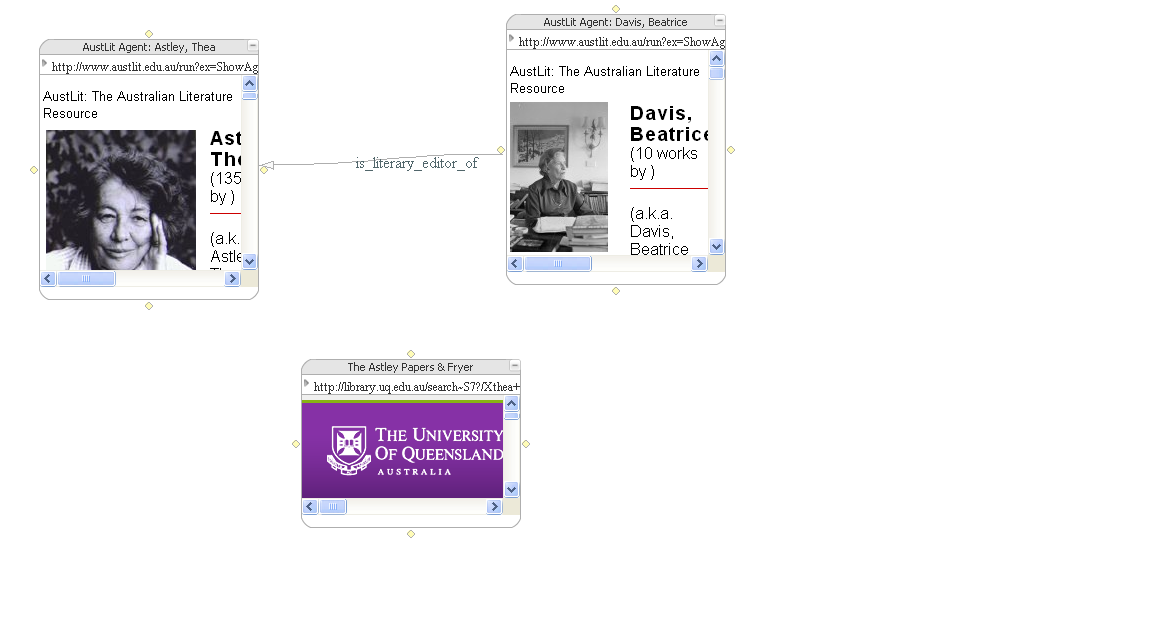
author and their literary editor adds a link to the network of Australian print culture, such as this relationship between Thea Astley and Beatrice Davis. Automatically inferring relationships from AustLit data and manually creating relationships using LORE will provide a foundation for future research into the social networks of Australian literature.

To see how relationships can be created using LORE, please visit the Aus-e-Lit Project Site or AustLit. Links to updated video demonstrations will soon be added, providing more detailed information about all Aus-e-Lit tools. Until then, please visit the current demo page.

And anyone interested in helping to better define the definitions of relationships between people and organisations in literary or print culture studies .... We'd love to hear from you.


Tuesday, March 30, 2010

Compound Objects

With an increasing amount of images and full-text being digitised and delivered by local, national and international institutions, the need to be able to bookmark, relate and describe these resources is becoming more and more necessary. The Aus-e-Lit Project aims to assist researchers by developing tools that extend the specifications and protocols delivered by the Open Archives Initiative, specifically specifications relating to Object Re-use and Exchange. For researchers in the field of Australian literary and print culture studies, Aus-e-Lit tools developed from these principles will allow them to gather text, image, video and audio files in their Firefox browser window and realate them to specific fields in an AustLit Record. I'll run through a few examples to demonstrate what I mean.

If you're unfamiliar with the Aus-e-Lit Project, follow the link provided for a full description of the project's aims, a number of technical articles, and a few video demonstrations of the tools in action. As the interface is constantly changing, new videos will be produced later in 2010, but, for now, these give a good idea of the basic functions of compound objects and the associated annotation tool.

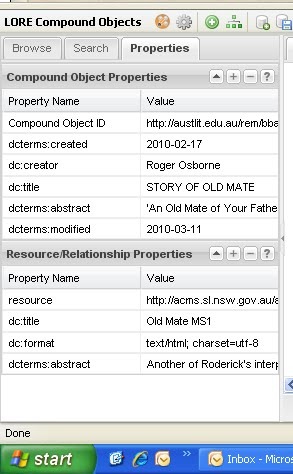
LORE (Literature Object Re-use and Exchange) is the name given to the software that has been developed as an extension to the Firefox browser. A small file can be easily installed in the Firefox "Add-ons" found in the Tools menu of the browser. Once this is done, you are free to bookmark and describe internet resources in as little detail or as much detail as you want. The screen-shot at the top of this posting is a collection of resources (AustLit records, text files and images) available on the internet. These resources have been bookmarked and the user has begun to create relationships between the reources and add metadata to describe each resource in order to gather as much information as they can for future reflection or for sharing with peers.


By adding metadata derived from Dublin Core standards to specified fields, the collection of resources and the relationships between them become more meaningful. Ultimately, users will have the ability to choose whether they want to share this information with others, but the potential for collaborative research on a large scale is very significant.

One of the most obvious examples is the creation of social networks around particular periods or cultural groups. At the moment AustLit records limited relationships between people (primarily "is influenced by"), but networks of influence could be created by relating the AustLit records of individuals associated, say, with the Bulletin in the 1890s. The variety of relationships that A.G.Stephens had with writers, publishers, artists could be clearly defined to visualise the networks of influence that determined who was published or reviewed and why. Is it just literary, or are their other factors determined by the various relationships between people. Such an activity could be done collaboratively by small, large and mass groups of contributors, building networks of influence that might begin with A. G. Stephens but merge with other editors, publishers, critics and writers. In collaboration, a better understanding of the print culture networks would emerge quickly, potentially revealing clusters of influence that have escaped notice.

Several important contributors to the development of Aus-e-Lit tools will sit on a panel at the annual conference of ASAL, 8-10 July 2010. Over the next few months their experiments will be featured here to demonstrate what is possible as far as the discovery, organisation, description and communication of related internet resources is concerned. Textual transmission, adapatation, artist-poet collaborations, and collaborative interpretation will be some of the themes covered. Please leave a comment if you'd like to join the conversation or visit us at ASAL.

Thursday, January 28, 2010

Testing LORE with an Eye on ASAL 2010.

Aus-e-Lit development is approaching a very busy time. Members of our testing group are planning small projects that can be supported by annotation and 'compound object' authoring tools (known as LORE: Literature Object Re-Use and Exchange) that our software engineers, Anna Gerber and Andrew Hyland, are busily 'refactoring' and 'debugging'. A new version of the tool is imminent, but video demos of older versions can be seen at the Aus-e-Lit Project page.

Our Aus-e-Lit testing group will propose a panel session to the organisers of ASAL 2010, UNSW, 7-10 July 2010. The projects will include explorations of textual scholarship and scholarly editing, adaptation, literary criticism, film studies and the relationship between poets and artists in the production of limited edition artist's books. Issues such as authorship, textual integrity, aesthetics and reception will be discussed with particular attention paid to the way we might talk about these issues within the emerging field of digital humanities. The major themes and issues will emerge through testing and I will report on them here.

Over the next few weeks I'll contribute posts that look more closely at the way LORE supports individual or collaborative annotation and guide you through the world of compound objects and the potential of the semantic web for those working with Australian writers, artists, publishers and readers. I'll talk more fully about the foundation of this project in the Open Archives Initiative and speculate where a project such as this might lead in the years to come. Discussion might also lead to proposals for new names for the thing that is currently known as a compound object! Your recommendations on this will be enthusiastically received, but 'Fred' will not be accepted.

Tuesday, June 16, 2009

Doris Lessing's GOLDEN NOTEBOOK

New technologies promise to support collaborative research and other interpretive activities, and so it's really good when you see a well-structured example appear on the internet.

In an 'experiment in close-reading', seven critics, scholars and creative writers were invited to participate in an online discussion of Doris Lessing's novel The Golden Notebook. With the approval of the author and publisher Harper Collins, the full-text of the novel is provided so that those outside of the chosen group can consider the 'readings' provided by each contributor with easy reference to the page or pages under discussion. The concentration of discussion on particular pages can also be examined in a section that arranges comments per page in descending order.

The 'reading' of the novel began on 8 November 2008 and continued for approximately six weeks. Observers have been invited to comment in a Forum and the chosen readers reflected on their experience in a blog. This is all arranged in a very simple interface that enables visitors to concentrate on the text of the novel and the attached comments.

Comments in the Forum show a mixed reaction to the experiment, some questioning the veracity of the 'reading' being done online and others suggesting the need for readers outside of the English-speaking world. But, despite this criticism, most people who have added their voice to the discussion have been positive. For an online experiment, the small numbers who have posted comments might be disappointing to the organisers, but one might wonder how this could develop as more people become aware of the site's existence.

This experiment in close reading provides a very good model for similar initiatives using full-text through the AustLit portal. Agreements with authors and publishers will have to be made for contemporary works, but those works out of copyright provide the possibility for trial and experimentation.

The Aus-e-Lit Project will develop new annotation tools to support experiments like The Golden Notebook and will soon invite contributors to participate in an annotation event that centres on The Bulletin Story Book which contains a number of well-known Australian short stories, including Henry Lawson's 'The Drover's Wife', Barbara Baynton's 'The Tramp' (a version of 'The Chosen Vessel') and Arthur Hoey Davis' 'On Our Selection' among many other well-known and long-forgotten stories.

This event will inform the development of collaborative annotation tools by inviting wide participation and feedback on the technical and conceptual delivery of such a service to researchers in the field of Australian literature. The release of this development model will be announced here and through other AustLit networks in the near future. The prototype will be discussed in a special session at ASAL 2009.

Wednesday, June 3, 2009

Aus-e-Lit Project Update

Over the last six months Aus-e-Lit team members have been busy with technical and conceptual development and have appeared at a number of events to spread the news about the tools that will soon enable greater engagement with AustLit data.

Papers have been presented at
eResearch Australasia 2008, International Digital Curation Conference 2008, International Conference on Asia-Pacific Digital Libraries 2008, International Conference on Open Repositories 2009 and Digital Humanities 2009. Copies of these papers have been posted on the Project site - here.

The Project's goal is to help AustLit users to discover, organise, describe, analyse, collaborate and communicate in a networked environment. This will be achieved by providing a federated search of selected databases, an annotation service and a new tool, LORE, that will enable users to create and publish compound digital objects in a variety of presentation forms. You can view a video of these tools in use that was prepared by Anna Gerber for Open Repositories 2009.

In addition to conference presentations, these new tools have been demonstrated to members of the Austlit user community based at the University of Queensland. AustLit personnel and staff members from the School of English, Media Studies and Art History have been asked to comment on prototypes of the Aus-e-Lit tools. Feedback on the prototypes has been positive and comments have informed the preparation of a demonstration and workshop at the annual conference of the Association for the Study of Australian Literature.

In consultation with members of research communities active in the field of Australian literary studies, the project team is preparing several examples that will be used for demonstration at ASAL and beyond.

The project has attracted the interest of Professor Paul Eggert who has a considerable international reputation in the field of scholarly editing. Professor Eggert is currently working on a major scholarly edition of the works of the colonial Australian poet, Charles Harpur. Harpur's poetry exists in manuscript, periodical and book versions that reveal significant variation due to the poet's constant revision towards a collected edition that failed to appear during his lifetime. An edition of Harpur's poetry was prepared after his death, but severe editorial intervention created texts that depart significantly from the last known manuscript versions. The Aus-e-Lit project is using the case of 'The Creek of the Four Graves' to develop tools to assist collaborative scholarly editing. You can see a video of the basic structure of the prototype here.

Discussion with teachers of Australian literature in EMSAH has isolated a few texts that can be used to develop tools that assist collaborative analysis of literary works. Henry Lawson's well-known short story 'The Drover's Wife' will be used as a test-case to investigate the benefits of collaborative annotation. Published in The Bulletin Story Book in 1901, its appearance in this book enables discussion of other texts such as Barbara Baynton's 'The Tramp' and Arthur Hoey Davis' 'On Our Selection' and an exploration of the literary culture of the 1890s that centres on writers whose work appeared in the Bulletin during that decade.

The project team has also been investigating the benefits of online text analysis tools like those offered by Tapor or demonstrated at the Willa Cather Archive. Over time and in consultation with AustLit users we'll be testing these tools and will direct users to the best of them so that AustLit research communities can take full advantage of the increasing amount of full text freely available on the web. In the near future the project will also offer data visualisation tools to support 'distant reading' of Australian literary history by drawing on the rich data source collected by AustLit.

Such visualisation will potentially help projects such as Professor David Carter's 'America Publishes Australia: Australian Books and American Publishers, 1890-2005.' Evidence accumulated during this project could potentially enhance AustLit records by providing information not normally indexed by AustLit: literary agents; publisher's representatives; editors; print runs; dustcover images; comprehensive bibliographical descriptions etc. Examples from this project will be developed to demonstrate how the accumulation of such data might be analysed and re-used for other research questions.

The potential for the re-use of digital objects is being explored with the help of AustLit's Black Words Research Community. Black Words team members are drafting a variety of thematic trails that can be created by using LORE to collect, organise and present web-based digital objects. These trails will eventually be delivered through the Black Words page and will inform the development of style sheets for other types of presentations from slide shows to illustrated essays. Of course, our thinking is often influenced by the exhibits now accumulating at NINES.

Following the forthcoming demonstration and workshop at ASAL, we hope to enagage more users with the various prototypes in order to prepare for a full usability study in 2010. We welcome comment at any time via this blog or by email to the project manager, Roger Osborne: r.osborne@uq.edu.au.


Friday, September 12, 2008

Australian Newspapers Beta

The National Libraries of Australia recently launched Australian Newspapers in a beta version. The project aims to digitise more than a dozen major newspapers from Australian capital cities, ranging in date from 1803 to 1954. Although the project is in a very early stage with limited coverage so far it will prove a significant resource for the study of Australian literature.

I conducted several searches on authors I am familiar with from my own research to see what sort of new information emerged. I'm particularly interested in Vance Palmer because of his dual role as a 'man of letters' and as a writer of popular fiction. Not only do you find reports of his radio addresses from the 1940s in the Canberra Times, but a number of serial versions of his early novels are also found in the Argus. The latter is particularly important because until now they had escaped the notice of AustLit indexers. For research on working writers, literary criticism, book news, readers and reading, Australian Newspapers is and will be an important resource.

The digitised images are quite clear and searches take you directly to the article in which key words appear. The text has been passed through an OCR process, but the results are generally quite poor. To address this shortcoming Australian Newspapers invites (and enables) users to make corrections to the full text. While this will never bring the full text to perfection, I imagine that well researched authors and topics will result in cleaner texts.

The coverage of Australian Newspapers is very patchy at the moment, but as more and more newspaper issues are added to the database, search results will become richer and researchers will get a better idea of the complex networks of Australia's literary culture and the extent to which working authors spread their work across the nation.

Wednesday, September 10, 2008

Digital Humanities: Past present and Future

On 2 September the Digital Humanities Symposium was hosted by the University of Western Sydney. A relatively small number attended the event, but the presentations and discussion were interesting and relevant to Aus-e-Lit

Willard McCarty talked about the Dictionary of Words in the Wild http://dictionary.mcmaster.ca/ and Paul Arthur talked about spatial history with particular reference to the Northbridge History Project http://www.northbridgehistory.wa.gov.au/ . Ien Ang talked about using the web-site DiverCities http://acl.arts.usyd.edu.au/threecities/index.php?option=com_content&task=view&id=25&Itemid=37 to facilitate intercultural dialogue. Andrew Murphie talked about open access and the rise of alternative forms of publication, noting the division between tradition and ‘non-hierarchical forms of authority’ See http://www.andrewmurphie.org/ for more. And Leonie Hellmers talked about her new role at http://www.intersect.org.au/ .

In the spirit of these projects, the Aus-e-Lit project aims to contribute to the development of digital humanities in Australia with its collaborative integration and annotation services. AustLit has already built a strong foundation of collaborative research by supporting more than a dozen Research Communities. The expansion of digital services provided through the Austlit interface will further support collaborative research in these projects and, hopefully, lead to the organisation of new research communities that will benefit from the Aus-e-Lit initiatives. In turn, new collaborations will contribute new ideas, assisting the Aus-e-Lit team to develop a service that will assist researchers in the fields of Australian literature and print culture for many years to come.

In the coming weeks and months, this blog will review many old and new digital projects to discover the depth and quality of digital humanities in Australia and to compile a list of web-sites that might inspire other researchers to embark on their own digital projects. Some of these will focus on literature, but many will cross disciplines, providing a view of the past and present that is relevant to all.