Showing posts with label annotation. Show all posts

Tuesday, March 30, 2010

Compound Objects

With an increasing amount of images and full-text being digitised and delivered by local, national and international institutions, the need to be able to bookmark, relate and describe these resources is becoming more and more necessary. The Aus-e-Lit Project aims to assist researchers by developing tools that extend the specifications and protocols delivered by the Open Archives Initiative, specifically specifications relating to Object Re-use and Exchange. For researchers in the field of Australian literary and print culture studies, Aus-e-Lit tools developed from these principles will allow them to gather text, image, video and audio files in their Firefox browser window and realate them to specific fields in an AustLit Record. I'll run through a few examples to demonstrate what I mean.

If you're unfamiliar with the Aus-e-Lit Project, follow the link provided for a full description of the project's aims, a number of technical articles, and a few video demonstrations of the tools in action. As the interface is constantly changing, new videos will be produced later in 2010, but, for now, these give a good idea of the basic functions of compound objects and the associated annotation tool.

LORE (Literature Object Re-use and Exchange) is the name given to the software that has been developed as an extension to the Firefox browser. A small file can be easily installed in the Firefox "Add-ons" found in the Tools menu of the browser. Once this is done, you are free to bookmark and describe internet resources in as little detail or as much detail as you want. The screen-shot at the top of this posting is a collection of resources (AustLit records, text files and images) available on the internet. These resources have been bookmarked and the user has begun to create relationships between the reources and add metadata to describe each resource in order to gather as much information as they can for future reflection or for sharing with peers.
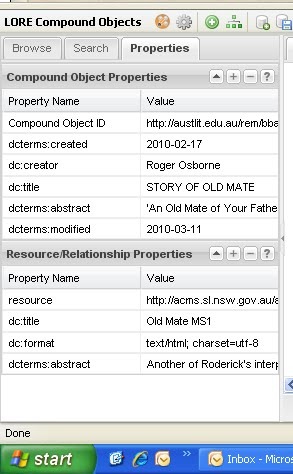


By adding metadata derived from Dublin Core standards to specified fields, the collection of resources and the relationships between them become more meaningful. Ultimately, users will have the ability to choose whether they want to share this information with others, but the potential for collaborative research on a large scale is very significant.

One of the most obvious examples is the creation of social networks around particular periods or cultural groups. At the moment AustLit records limited relationships between people (primarily "is influenced by"), but networks of influence could be created by relating the AustLit records of individuals associated, say, with the Bulletin in the 1890s. The variety of relationships that A.G.Stephens had with writers, publishers, artists could be clearly defined to visualise the networks of influence that determined who was published or reviewed and why. Is it just literary, or are their other factors determined by the various relationships between people. Such an activity could be done collaboratively by small, large and mass groups of contributors, building networks of influence that might begin with A. G. Stephens but merge with other editors, publishers, critics and writers. In collaboration, a better understanding of the print culture networks would emerge quickly, potentially revealing clusters of influence that have escaped notice.

Several important contributors to the development of Aus-e-Lit tools will sit on a panel at the annual conference of ASAL, 8-10 July 2010. Over the next few months their experiments will be featured here to demonstrate what is possible as far as the discovery, organisation, description and communication of related internet resources is concerned. Textual transmission, adapatation, artist-poet collaborations, and collaborative interpretation will be some of the themes covered. Please leave a comment if you'd like to join the conversation or visit us at ASAL.

Tuesday, February 23, 2010

Towards Open Access and Collaborative Research

WE use the word collaboration quite freely these days and point to collaborative research as a promising direction for humanities scholars to take. But in a field where lone scholars continue to dominate research output with single-authored articles and monographs, there is understandable resistance to growing institutional pressure to collaborate.

As those of us who work in the academy know all too well, measurement of research output is closely connected to the trajectory of our careers and so points scored are jealously guarded as tokens of value to be collected and redeemed at times of promotion or institutional movement. But as the potential of large-scale collaborative projects become more possible with the development of tools designed to enable contributions from a widely dispersed collection of scholars, this model of reward has become problematic.

The authoring tools being developed by the Aus-e-Lit Project fall right in the middle of this problematic area because of the support they give to multiple contributors from various levels of the academy, the community of independent scholars or, potentially, the general public.

The ANNOTATION TOOL will allow users to enhance AustLit records by adding information about a work or an author that would not normally be indexed by AustLit. For instance, information about the role of a literary agent in the publication of a particular edition could be added, providing a foundation for generating networks of influence in the publishing industry. If we can imagine scores of independent researchers contributing such information, cultural fields could emerge from the contributed data that tell us more about the publishing industry than we currently know.

The COMPOUND OBJECT AUTHORING TOOL allows users to define relationships between AustLit records and the growing number of disparate resources delivered via the internet by local, national and international archives and libraries. Using this tool a researcher could connect all available digital images and transcriptions of a work to their respective AustLit records and generate a digital archive to which the researcher's colleagues can contribute explanatory and textual notes that help to explain the work's textual transmission, its reception at various times, or its possible meanings in literary and cultural terms.

All of this connecting and describing is supported by a format known as RDF (Resource Description Framework) that delivers (currently) the internet resources through a Firefox browser. In this research environment, no images or text are saved, relieving the user of maintaining an archive or worrying about copyright. Ultimately, engagement with digitised archival material through the Aus-e-Lit interface will enrich the archival material by adding enhanced descriptions in stand-off markup that is stored in an Aus-e-Lit repository as RDF. Click on the Video Demo link to see the tools in action.

In the Aus-e-Lit interface all contributions can be identified by author with an associated date and time stamp. Such an environment supports peer-reviewing at a micro-level, allowing a researcher's work to be validated, quantified and assessed. At this early stage of development there is no established reviewing process, but such contributions to knowledge could provide an alternative or a supplement to the conventional article or monograph.

A fertile research environment emerges with tools that support the aggregation of disparate resources and annotations that describe these resources and the relationships between them. Such research environments have already emerged in the sciences, but an application in the data-rich environment already provided by AustLit is obvious. Models such as 'open notebook science' or 'enhanced publications' or 'mesotext' are available for AustLit researchers to consider, all of which favour open-source data with crowdsourcing contributions that make the most of publicly funded data and the publicly funded expertise that can contribute analyses.

Such models show the promise of Aus-e-Lit tools, but this promise pushes the boundaries of academic reward, publishing, copyright and the potential for collaboration in the near future. As we continue to test those boundaries, the annotation and compound-object authoring tools developed by the Aus-e-Lit Project will make a valuable contribution to the practice and theory of humanities research.

Tuesday, June 16, 2009

Doris Lessing's GOLDEN NOTEBOOK

New technologies promise to support collaborative research and other interpretive activities, and so it's really good when you see a well-structured example appear on the internet.

In an 'experiment in close-reading', seven critics, scholars and creative writers were invited to participate in an online discussion of Doris Lessing's novel The Golden Notebook. With the approval of the author and publisher Harper Collins, the full-text of the novel is provided so that those outside of the chosen group can consider the 'readings' provided by each contributor with easy reference to the page or pages under discussion. The concentration of discussion on particular pages can also be examined in a section that arranges comments per page in descending order.

The 'reading' of the novel began on 8 November 2008 and continued for approximately six weeks. Observers have been invited to comment in a Forum and the chosen readers reflected on their experience in a blog. This is all arranged in a very simple interface that enables visitors to concentrate on the text of the novel and the attached comments.

Comments in the Forum show a mixed reaction to the experiment, some questioning the veracity of the 'reading' being done online and others suggesting the need for readers outside of the English-speaking world. But, despite this criticism, most people who have added their voice to the discussion have been positive. For an online experiment, the small numbers who have posted comments might be disappointing to the organisers, but one might wonder how this could develop as more people become aware of the site's existence.

This experiment in close reading provides a very good model for similar initiatives using full-text through the AustLit portal. Agreements with authors and publishers will have to be made for contemporary works, but those works out of copyright provide the possibility for trial and experimentation.

The Aus-e-Lit Project will develop new annotation tools to support experiments like The Golden Notebook and will soon invite contributors to participate in an annotation event that centres on The Bulletin Story Book which contains a number of well-known Australian short stories, including Henry Lawson's 'The Drover's Wife', Barbara Baynton's 'The Tramp' (a version of 'The Chosen Vessel') and Arthur Hoey Davis' 'On Our Selection' among many other well-known and long-forgotten stories.

This event will inform the development of collaborative annotation tools by inviting wide participation and feedback on the technical and conceptual delivery of such a service to researchers in the field of Australian literature. The release of this development model will be announced here and through other AustLit networks in the near future. The prototype will be discussed in a special session at ASAL 2009.

Wednesday, June 3, 2009

Aus-e-Lit Project Update

Over the last six months Aus-e-Lit team members have been busy with technical and conceptual development and have appeared at a number of events to spread the news about the tools that will soon enable greater engagement with AustLit data.

Papers have been presented at
eResearch Australasia 2008, International Digital Curation Conference 2008, International Conference on Asia-Pacific Digital Libraries 2008, International Conference on Open Repositories 2009 and Digital Humanities 2009. Copies of these papers have been posted on the Project site - here.

The Project's goal is to help AustLit users to discover, organise, describe, analyse, collaborate and communicate in a networked environment. This will be achieved by providing a federated search of selected databases, an annotation service and a new tool, LORE, that will enable users to create and publish compound digital objects in a variety of presentation forms. You can view a video of these tools in use that was prepared by Anna Gerber for Open Repositories 2009.

In addition to conference presentations, these new tools have been demonstrated to members of the Austlit user community based at the University of Queensland. AustLit personnel and staff members from the School of English, Media Studies and Art History have been asked to comment on prototypes of the Aus-e-Lit tools. Feedback on the prototypes has been positive and comments have informed the preparation of a demonstration and workshop at the annual conference of the Association for the Study of Australian Literature.

In consultation with members of research communities active in the field of Australian literary studies, the project team is preparing several examples that will be used for demonstration at ASAL and beyond.

The project has attracted the interest of Professor Paul Eggert who has a considerable international reputation in the field of scholarly editing. Professor Eggert is currently working on a major scholarly edition of the works of the colonial Australian poet, Charles Harpur. Harpur's poetry exists in manuscript, periodical and book versions that reveal significant variation due to the poet's constant revision towards a collected edition that failed to appear during his lifetime. An edition of Harpur's poetry was prepared after his death, but severe editorial intervention created texts that depart significantly from the last known manuscript versions. The Aus-e-Lit project is using the case of 'The Creek of the Four Graves' to develop tools to assist collaborative scholarly editing. You can see a video of the basic structure of the prototype here.

Discussion with teachers of Australian literature in EMSAH has isolated a few texts that can be used to develop tools that assist collaborative analysis of literary works. Henry Lawson's well-known short story 'The Drover's Wife' will be used as a test-case to investigate the benefits of collaborative annotation. Published in The Bulletin Story Book in 1901, its appearance in this book enables discussion of other texts such as Barbara Baynton's 'The Tramp' and Arthur Hoey Davis' 'On Our Selection' and an exploration of the literary culture of the 1890s that centres on writers whose work appeared in the Bulletin during that decade.

The project team has also been investigating the benefits of online text analysis tools like those offered by Tapor or demonstrated at the Willa Cather Archive. Over time and in consultation with AustLit users we'll be testing these tools and will direct users to the best of them so that AustLit research communities can take full advantage of the increasing amount of full text freely available on the web. In the near future the project will also offer data visualisation tools to support 'distant reading' of Australian literary history by drawing on the rich data source collected by AustLit.

Such visualisation will potentially help projects such as Professor David Carter's 'America Publishes Australia: Australian Books and American Publishers, 1890-2005.' Evidence accumulated during this project could potentially enhance AustLit records by providing information not normally indexed by AustLit: literary agents; publisher's representatives; editors; print runs; dustcover images; comprehensive bibliographical descriptions etc. Examples from this project will be developed to demonstrate how the accumulation of such data might be analysed and re-used for other research questions.

The potential for the re-use of digital objects is being explored with the help of AustLit's Black Words Research Community. Black Words team members are drafting a variety of thematic trails that can be created by using LORE to collect, organise and present web-based digital objects. These trails will eventually be delivered through the Black Words page and will inform the development of style sheets for other types of presentations from slide shows to illustrated essays. Of course, our thinking is often influenced by the exhibits now accumulating at NINES.

Following the forthcoming demonstration and workshop at ASAL, we hope to enagage more users with the various prototypes in order to prepare for a full usability study in 2010. We welcome comment at any time via this blog or by email to the project manager, Roger Osborne: r.osborne@uq.edu.au.